Overview
This is a top level explanation of Baked Studios' VFX Pipeline.
Introduction
Baked's pipeline has a few key parts: Ingest, Work, Render and Export.
Ingest - This is where we bring in media from clients and make sure it goes where it needs to go uniformly and repeatably. Files need to be in the same place across projects so we know where to find them. Files need to be formatted consistently to make things easier. To help with this, we worked with Nodes & Layers to make an Ingest app.
Work - We use the Flow Production Tracking Pipeline Toolkit to keep things efficient for artists and coordinators. While other programs out there exist, like OpenPype, Flow is the most production ready. We use these tools mostly 'as is', meaning we rely directly on a trusted partner, Autodesk, to provide the best and most widely used tools available. Documentation for Autodesk's Flow Production Tracking Toolkit can be found here.
Render - We use a render farm that has required extensive configuration to work for us. The render farm means that artists can continue working while they're rendering out large batches of files. Most of the integration between our pipeline and our render farm is out of the box Thinkbox Deadline. The exception is a NukeTranscoder plugin supplied by our friends at Nodes & Layers.
Export - We use Export Profiles and the Export App to create various flavors of movies based on rendered EXRs from artists. This process is managed by Flow Production Tracking, Nodes & Layers export app (an app for Toolkit), the Nodes & Layers NukeTranscoder (a plugin for Deadline) and our render farm, managed by Deadline.
Toolkit vs Apps for Toolkit
An important distinction for our pipeline (which is based off the Flow Production Tracking Pipeline Toolkit) is the difference between Toolkit itself and applications built for toolkit.
Toolkit is like the OS, and apps are well, apps. You can control your OS system settings (that's our config), and then you can control your apps individually. Nodes & Layers makes apps for our toolkit configuration.
Multi-Location Support
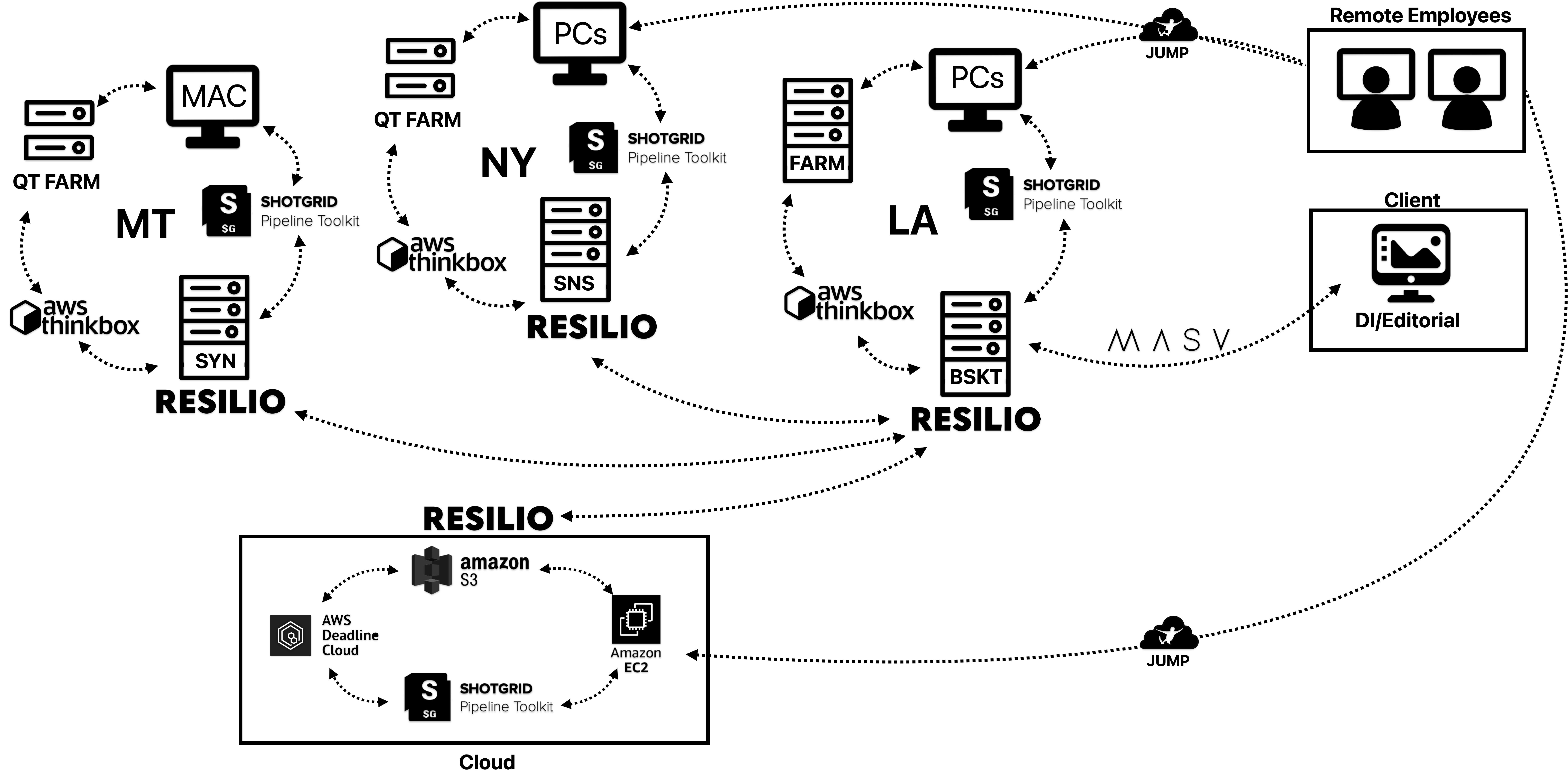
Baked is a multi-location company with hubs in Los Angeles, New York and Montana. We designed our pipeline with an open door to a future in the cloud. Incorporating a hybrid workflow between cloud and on-premise systems is complex, but crucial to a modern VFX workflow.
Bird's-Eye View
Baked's pipeline is a bunch of services put together to make up something we can use. It's a buy-don't-build set up that mostly utilizes proprietary software as a service (SAAS) companies that we subscribe to. For us, this works. This is how some of that software and hardware works together in a big system: